कृष्णं वन्दे जगद्गुरुम्।”
“नमः शिवाय शान्ताय नीलकण्ठाय शम्भवे।
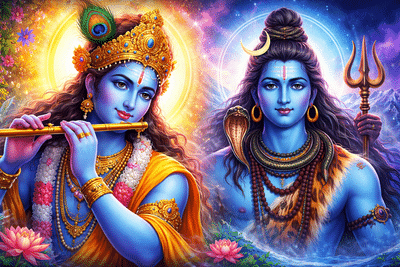
From temple walls to calendar art, from classical paintings to modern digital posters, two of Hinduism’s most beloved deities are almost always depicted in blue. Krishna, the enchanting flute player of Vrindavan, glows like a dark rain cloud. Shiva, the meditative ascetic of Kailash, carries the calm blue aura of eternity, with his throat famously known as Neelkanth.
But here is the surprising part.
Neither scripture describes them as “blue” in a biological sense. The blue color is symbolic, philosophical, and deeply spiritual. It represents ideas far greater than physical appearance. When understood correctly, this color opens a gateway to understanding the nature of divinity itself.
So why are Krishna and Shiva blue? The answer lies in five profound meanings hidden within the tradition.
1. Blue Represents Infinity 
Look at the sky. Look at the ocean. Both appear blue, vast, and endless.
In Hindu philosophy, the Supreme Reality is infinite. It cannot be confined, measured, or limited. Blue became the artistic language to express that boundlessness.
Krishna is often described in the Bhagavata Purana as “meghashyama,” meaning dark like a rain-laden cloud. Rain clouds nourish the earth and sustain life. Their color is deep blue. This imagery connects Krishna with both infinity and life-giving abundance.
Shiva, as Mahadeva, transcends time and space. He exists before creation and after dissolution. Blue reflects that limitless presence. It visually reminds devotees that the divine stretches beyond human perception.
The truth is that blue was chosen to communicate infinity in a way the human mind could grasp.
2. Blue Symbolizes Depth of ConsciousnessThe deeper the ocean, the darker its blue. Depth has always been associated with wisdom and consciousness.
Krishna is not merely a charming cowherd. In the Bhagavad Gita, he reveals the highest spiritual knowledge about duty, devotion, and liberation. His blue form suggests profound inner depth. His teachings are not surface level philosophy but insights into the nature of existence itself.
Shiva, the Adiyogi, sits in eternal meditation. He represents the stillness at the center of the universe. His blue tone reflects the depth of meditative awareness. It signals that the divine mind is vast, silent, and immeasurable.
The color teaches that true wisdom lies beneath the surface. To understand divinity, one must dive deep.
3. Blue Reflects Compassion That Absorbs Negativity 
One of the most powerful stories in Hindu mythology explains Shiva’s blue throat. During the Samudra Manthan, the cosmic churning of the ocean, a deadly poison called Halahala emerged. It threatened to destroy all creation. Shiva drank the poison to save the universe. Parvati stopped it in his throat, turning it blue. Thus he became Neelkanth.
This story is not just mythological drama. It symbolizes supreme compassion. Shiva absorbs toxicity without letting it spread. Blue becomes the mark of sacrifice and protection.
Krishna too protects and restores balance whenever dharma declines. While he does not drink poison, his life is filled with acts of removing suffering and guiding humanity through chaos.
The blue color here stands for the divine ability to transform negativity into harmony.
4. Blue Represents Detachment and CalmPsychologically, blue is associated with peace and tranquility. It is calming to the human mind.
Shiva embodies total detachment. He sits on Mount Kailash, covered in ash, free from material desires. His blue presence radiates serenity. Even in destruction, he remains composed.
Krishna, though fully engaged in the world, teaches detachment in action. In the Gita, he emphasizes performing one’s duty without attachment to outcomes. His blue form conveys balance. He participates in life without being bound by it.
The truth that surprises many is this. The blue color is not about exotic beauty. It is about emotional mastery and spiritual equilibrium.
5. Blue Bridges Form and Formlessness  Monday worship is linked with seeking harmony in marriage like Shiva and Parvati.
Here is the most fascinating insight.
The sky appears blue, yet it has no actual color. Its blueness is an optical effect caused by light scattering. Similarly, the ocean reflects the sky and appears blue.
In Hindu theology, the Supreme Reality is ultimately formless. Yet humans relate more easily to form. Blue becomes a symbolic bridge. It gives shape to the infinite without limiting it.
Krishna and Shiva are both personal deities. Yet they represent the impersonal, formless Brahman described in the Upanishads. Their blue skin communicates that paradox. Visible yet beyond visibility. Defined yet undefined.
The truth that surprises many people is that the blue form is not literal. It is a spiritual metaphor pointing toward the indescribable.
Contact to : xlf550402@gmail.com
Copyright © boyuanhulian 2020 - 2023. All Right Reserved.