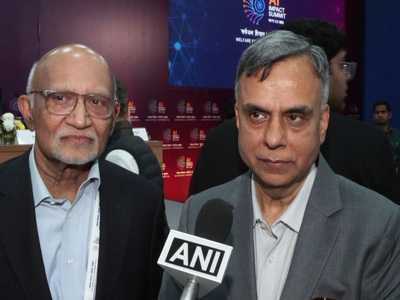
New Delhi [India], February 17 (ANI): Industry leaders at the AI-India Impact Summit say India is moving from a services-led economy to a product-driven one as deep technology becomes a major area for investment. Chiratae Ventures Founder and Chairman Sudhir Sethi and India Deep Tech Alliance (IDTA) Chair and Managing Partner of Celesta Capital Arun Kumar believe that every part of the technology sector now holds promise.
The shift is visible in the background of Indian entrepreneurs. Sudhir Sethi noted that 20 years ago, founders usually came from service companies like HCL and Wipro. Later, they came from the Indian offices of global giants like Google and Microsoft, followed by Indian e-commerce firms like Flipkart. Today, they are emerging from product design and engineering units.
Sethi said this change marks a transition from services to the product industry. He stated, "That's a very big mark change. That's a transition from the services to the product industry. So there is very little left, robotics, industrial, consumer robotics, et cetera."
Investment is now moving into fields like defence, space, and biopharma. Arun Kumar identified semiconductors, advanced manufacturing, and the mix of biology and computer science as key areas for the future. He also highlighted the role of Global Capability Centres in developing advanced technology.
Kumar said these centres are a significant source of innovation. He noted, "Actually the global capability centres of the various companies that are doing advanced development, they're also a source."
Policy changes are needed to help these companies grow. Kumar suggested that the government should focus on making it easier for entrepreneurs to do business and fast-tracking regulations. He also recommended connecting government programs like the Research, Development and Innovation Fund with the SEBI framework to help with approvals.
Sethi emphasised that deep-tech companies need a different kind of funding because they take longer to develop. He suggested that the government allow for longer holding periods of up to 15 years. He said, "Deep technology companies' average holding periods are not going to be six and seven years, they're going to be 15 years that we need to allow."
The pace of regulatory change in India is increasing. Sethi noted that authorities are recognising the need for more capital and better structures. He mentioned that India is finding its own way to manage this innovation. Sethi said, "I think India is discovering that. But what I'm very happy is that India is discovering that at a faster pace."
Kumar added that any move to ease the flow of capital would be an important step. He said, "Anything that allows and eases the flow of capital into deep tech that recognises the horizons that deep tech are different from normal horizons, longer term horizon, would be a very important step." (ANI)
Contact to : xlf550402@gmail.com
Copyright © boyuanhulian 2020 - 2023. All Right Reserved.