
New-age companies such as Oyo, Ola, Zomato, and Udaan continue to be launchpads for first-time founders to go it on their own.
In 2023, ET reported that the second generation of the startup mafia had given rise to 253 companies. That number has since increased sharply. As of March 2026, founders emerging from these companies have created around 360 startups cumulatively, according to data from Longhouse analysed by ET.
The term startup mafia refers to cohorts of former employees who go on to build new companies.
The first generation mafia were the likes of Flipkart and Paytm, while the third gen are firms like Razorpay, Cred, Meesho, PhonePe, and Unacademy.
Among the second generation companies, or Mafia 2.0, the maximum startups have come from enterprise software firm Freshworks — the number of founders emerging from the company has more than doubled from 22 in 2023 to 51 in 2026, cumulatively.
Food delivery platform Zomato has also seen a sharp rise in founders, from 15 to 51 over the same period, while SaaS major Zoho saw 41 founders compared with 16 in 2023.
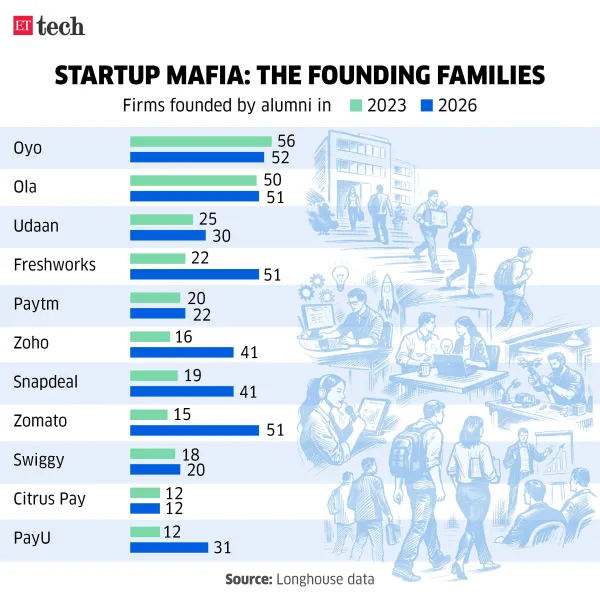
Marketplace platform Snapdeal has also seen its founder network expand significantly, growing from 19 in 2023 to 41 in 2026. In the fintech space, PayU saw the number of founders increase from 12 to 31.
Oyo accounted for 53 founders in 2026, while Ola stands at 51. B2B ecommerce firm Udaan has seen its alumni founder base expand from 25 to 30.
Investors say such networks are a natural outcome of companies that scale rapidly, as employees gain exposure to building products, managing teams, and raising capital.
"These shifts indicate that entrepreneurship is no longer confined to a small group — it is becoming a natural career progression within the startup ecosystem," said Anshuman Das, chief executive and founder, Longhouse.
Das also highlighted that the gestation period — the gap between working at a startup and launching one’s own venture — has shortened, driven largely by the increasing maturity of India’s startup ecosystem.
Investors said a combination of existing wealth, future liquidity potential, and access to a stronger funding ecosystem gives startup employees the confidence and financial cushion needed to launch their own ventures early in their careers.
Also Read: Startup Mafia 3.0: Razorpay, Cred, Meesho help spawn 200+ founders
In 2023, ET reported that the second generation of the startup mafia had given rise to 253 companies. That number has since increased sharply. As of March 2026, founders emerging from these companies have created around 360 startups cumulatively, according to data from Longhouse analysed by ET.
The term startup mafia refers to cohorts of former employees who go on to build new companies.
The first generation mafia were the likes of Flipkart and Paytm, while the third gen are firms like Razorpay, Cred, Meesho, PhonePe, and Unacademy.
Among the second generation companies, or Mafia 2.0, the maximum startups have come from enterprise software firm Freshworks — the number of founders emerging from the company has more than doubled from 22 in 2023 to 51 in 2026, cumulatively.
Food delivery platform Zomato has also seen a sharp rise in founders, from 15 to 51 over the same period, while SaaS major Zoho saw 41 founders compared with 16 in 2023.
Marketplace platform Snapdeal has also seen its founder network expand significantly, growing from 19 in 2023 to 41 in 2026. In the fintech space, PayU saw the number of founders increase from 12 to 31.
Oyo accounted for 53 founders in 2026, while Ola stands at 51. B2B ecommerce firm Udaan has seen its alumni founder base expand from 25 to 30.
Investors say such networks are a natural outcome of companies that scale rapidly, as employees gain exposure to building products, managing teams, and raising capital.
"These shifts indicate that entrepreneurship is no longer confined to a small group — it is becoming a natural career progression within the startup ecosystem," said Anshuman Das, chief executive and founder, Longhouse.
Das also highlighted that the gestation period — the gap between working at a startup and launching one’s own venture — has shortened, driven largely by the increasing maturity of India’s startup ecosystem.
Investors said a combination of existing wealth, future liquidity potential, and access to a stronger funding ecosystem gives startup employees the confidence and financial cushion needed to launch their own ventures early in their careers.
Also Read: Startup Mafia 3.0: Razorpay, Cred, Meesho help spawn 200+ founders