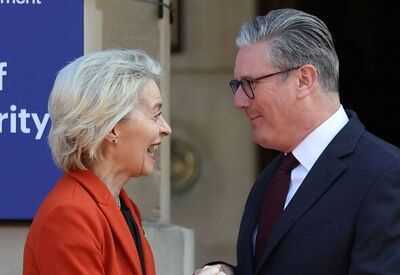
As Keir Starmer pursues his reset with the EU, a new Treasury report has exposed the UK's continued £1.3 billion payment to Brussels in 2025, raising fresh questions about Britain's leverage in ongoing negotiations. The European Union Finances Statement 2025, published by HM Treasury on March 26, details how Britain continued to meet its obligations under the Withdrawal Agreement through a series of euro-denominated invoices paid in monthly instalments.
The document shows the full £1.3 billion was transferred last year via two invoices issued by the EU in April and September, with the April sum settled in four instalments from June to September and the September invoice paid in eight monthly instalments from October to May. Frank Furedi, executive director of the think tank MCC Brussels, said: "The fact that the UK is still paying £1.3 billion in 2025 - years after formally leaving the European Union - underlines how the Withdrawal Agreement locked Britain into a long tail of liabilities that few voters fully understood."
The Treasury's own figures show that between 2020 and the end of 2025, the UK paid a net £25.7 billion to Brussels. Table 3.A records gross payments of £42.2 billion over the period, offset by receipts, resulting in the £25.7 billion net outturn.
Table 3.B sets the overall Treasury point estimate for the entire financial settlement - including Article 50 extension costs - at £37.9 billion net.
The report confirms that these payments are managed through a rolling system of invoices and instalments stretching across the calendar year. The document explains the EU's invoicing process and the use of daily exchange rates to convert euro liabilities into sterling.
The overwhelming majority of this money is not ring-fenced, meaning it flows directly into the EU's general budget with limited transparency over how it is ultimately spent.
Only a specific portion - primarily related to UK pension liabilities (€333.9 million) and access to certain IT systems and databases (€1.4 million) - is treated as assigned revenue for specific purposes. The remainder enters the EU's central funds as unassigned revenue.
Mr Furedi added: "These payments are not even straightforward: they are made through a rolling system of invoices and instalments stretching across the year, reinforcing the sense that Brexit has not delivered a clean financial break.
"Moreover, the overwhelming majority of this money is not ringfenced, meaning it flows directly into the EU's general budget with limited transparency over how it is ultimately spent."
The report also identifies separate liabilities outside the main settlement. An additional £481 million remains outstanding for the UK's contribution to the European Development Fund.
Separate discussions continue over the EU's demands for extra payments linked to the "Global Margin of Commitments", with the Treasury noting ongoing negotiations under the Withdrawal Agreement's governance structures.
Payments related to UK participation in programmes such as Horizon Europe and Erasmus+ are handled under separate arrangements and are not included in these figures.
Mr Furedi concluded: "As Keir Starmer pursues his much-vaunted 'reset' with the EU, this lingering financial entanglement raises serious questions about how much leverage the UK really has.
"Far from drawing a line under membership, the UK remains tied into a complex web of obligations and ongoing negotiations - from residual liabilities to potential additional demands - which risk deepening, rather than resolving, the ambiguities of the Brexit settlement."
The Treasury document, the 45th in the series on the implementation of the settlement, stresses that all figures are based on actual transactions and current forecasts. It projects payments continuing until 2065, primarily for long-term pension liabilities.
Contact to : xlf550402@gmail.com
Copyright © boyuanhulian 2020 - 2023. All Right Reserved.