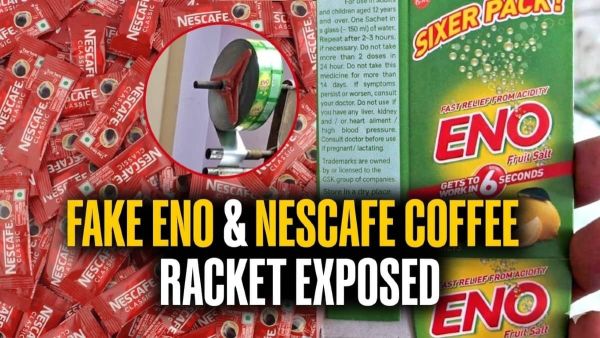
New Delhi: What looks like a trusted brand on a shop shelf can sometimes hide a dangerous truth. In a major crackdown, the Crime Branch of Delhi Police has uncovered a large-scale racket manufacturing fake versions of everyday consumer products, including ENO and Nescafé, raising serious concerns about public health and product safety.
Acting on specific intelligence, teams from the Cyber Cell and Southern Range conducted coordinated raids in Madhu Vihar, where two rented flats were being used as illegal production units. These were not small operations, police found both locations actively involved in manufacturing, packaging, and distributing counterfeit goods.
Officials said fake products worth nearly Rs 20 lakh were seized during the operation. The units were reportedly supplying these items across wholesale and retail networks, indicating a well-organised distribution chain.
Massive Seizure of Fake Goods and Raw Material
During the raids, authorities recovered more than 1 lakh fake ENO sachets and around 50,000 counterfeit Nescafé sachets. Alongside the finished products, large quantities of raw materials were also seized, including nearly 500 kg of coffee powder and multiple chemical drums suspected to be used in preparing fake antacid powder. Machinery used for production such as filling machines, foil rolls, sealing and packaging tools was also confiscated, showing the scale and sophistication of the operation.
Four Accused Arrested, Mastermind Tracked Down
The police have arrested four individuals linked to the racket. The alleged mastermind, Nitin Bhardwaj, was tracked and arrested from Dehradun using technical surveillance. Another key accused, Sanjay Bansal, was apprehended near Kashmere Gate, while two operatives- Uttam Das and Papai Das- were arrested from Delhi.
During interrogation, the accused revealed that the racket had been operational for the past two months.
Serious Health Risks Flagged
Officials highlighted that counterfeit ENO poses a direct health risk, as the chemical composition of such fake products is unknown and unregulated. Unlike genuine branded items, these products bypass safety checks and quality standards, making them potentially harmful for consumption.
The companies whose products were being duplicated have confirmed that the seized goods are fake, unauthorised, and illegally manufactured.
Case Registered, Probe Expands
An FIR (No. 86/26) has been registered under multiple sections of the Bharatiya Nyaya Sanhita (BNS), including charges related to cheating and public health violations. Investigators are now working to trace the wider supply chain and identify distributors who helped push these counterfeit products into the market.
This case is part of a growing pattern seen across India in 2026, where counterfeit FMCG products, from packaged foods to personal care items, have been increasingly detected in urban markets. Earlier this year, enforcement agencies in multiple states reported seizures of fake spices, edible oils, and even counterfeit medicines being sold under popular brand names.
The rise of such rackets is being driven by high consumer demand, weak supply chain checks, and the lure of quick profits. However, repeated crackdowns also indicate that authorities are stepping up surveillance, especially in metro cities like Delhi.
A Wake-Up Call for Consumers
The latest bust serves as a reminder for consumers to stay cautious while purchasing daily-use products. Checking packaging quality, verifying sellers, and avoiding unusually low prices can often help identify counterfeit goods.
As investigations continue, authorities say dismantling the entire network - from manufacturers to distributors - remains the top priority.
Contact to : xlf550402@gmail.com
Copyright © boyuanhulian 2020 - 2023. All Right Reserved.