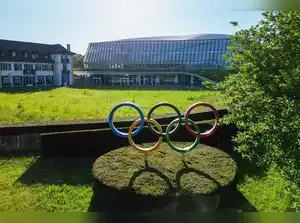
New York, The head of the International Testing Agency (ITA), the body that manages anti-doping programme in Olympic Games and other major global events, has expressed concern at the high rate of doping cases in India and athletes getting "advance notice prior to testing" and avoiding furnishing samples if there is doping control.
ITA Director General Benjamin Cohen said in a report that the International Olympic Committee (IOC) has passed on the message that if India wants to host the 2036 Games, the country needs to undergo "a lot of governance and structural reforms".
"We're concerned in general with the state of doping in India and we're hearing a lot of things happening on the ground," Cohen was quoted as saying by 'The Athletic', which covers sports for 'The New York Times'.
"We also hear stories of athletes running away when there is a doping control, and we hear of advance notice (given to athletes prior to testing)."
Besides overseeing anti-doping tests on behalf of the IOC, the Lausanne-based ITA also manages the anti-doping programme of around 50 international sports federations.
Cohen said he met with the officials of the New Delhi-based National Anti-Doping Agency (NADA) and Indian Olympic Association (IOA) at the recent Winter Olympics in Milano Cortina in Italy, and he was warmed by their apparent willingness to "team up with the ITA".
But, he also admitted that getting India to join forces with ITA won't be an easy task as that could be perceived (by India) as an admission of failure of its (anti-doping) system.
"I'm going to be frank: there is still some resistance to engage with the ITA, as there can be a perception in India that this is almost an admission of failure of the system, or that they're not going to be seen as competent enough to deal with their own problems, so they have to join forces with an independent international organisation.
"There's a bit of scepticism as to how it's going to be perceived in the Indian community. But I think they (India) are on the right track in that it is now known that the IOA and the Ministry of Sports want to do something: they want to invest. They have the resources, so I think it's just a matter of time," he said.
The ITA works with an increasing number of National Anti-Doping Organisations (NADOs) around the world to exchange intelligence and information, coordinate testing plans, and collaborate on specific cases or areas such as sample collection and education.
India has been topping the World Anti-Doping Agency's (WADA) list of dope offenders for three consecutive years with the highest positivity rate among major nations.
The country is scheduled to host the 2030 Commonwealth Games in Ahmedabad and is aspiring to become an Olympic host in 2036 in the Gujarat capital.
Doha, the capital of Qatar, is also in the running to host the 2036 Olympics, and the host city for that edition is expected to be known before 2028 Games in Los Angeles.
Last month, WADA President Witold Banka said at the sidelines of a conference on Global Anti-Doping Intelligence and Investigations Network (GAIIN) held in New Delhi that "nobody is blind" to India's serious doping problem but acknowledged that there have been "sincere efforts" to address it.
He had also said India is the biggest producer of Performance Enhancing Drug (PEDs) and steroids in the world.
ITA was created in 2018 as a non-profit foundation under the supervision of the WADA and the IOC to promote independence, expertise and transparency in the global fight against doping.
ITA Director General Benjamin Cohen said in a report that the International Olympic Committee (IOC) has passed on the message that if India wants to host the 2036 Games, the country needs to undergo "a lot of governance and structural reforms".
"We're concerned in general with the state of doping in India and we're hearing a lot of things happening on the ground," Cohen was quoted as saying by 'The Athletic', which covers sports for 'The New York Times'.
"We also hear stories of athletes running away when there is a doping control, and we hear of advance notice (given to athletes prior to testing)."
Besides overseeing anti-doping tests on behalf of the IOC, the Lausanne-based ITA also manages the anti-doping programme of around 50 international sports federations.
Cohen said he met with the officials of the New Delhi-based National Anti-Doping Agency (NADA) and Indian Olympic Association (IOA) at the recent Winter Olympics in Milano Cortina in Italy, and he was warmed by their apparent willingness to "team up with the ITA".
But, he also admitted that getting India to join forces with ITA won't be an easy task as that could be perceived (by India) as an admission of failure of its (anti-doping) system.
"I'm going to be frank: there is still some resistance to engage with the ITA, as there can be a perception in India that this is almost an admission of failure of the system, or that they're not going to be seen as competent enough to deal with their own problems, so they have to join forces with an independent international organisation.
"There's a bit of scepticism as to how it's going to be perceived in the Indian community. But I think they (India) are on the right track in that it is now known that the IOA and the Ministry of Sports want to do something: they want to invest. They have the resources, so I think it's just a matter of time," he said.
The ITA works with an increasing number of National Anti-Doping Organisations (NADOs) around the world to exchange intelligence and information, coordinate testing plans, and collaborate on specific cases or areas such as sample collection and education.
India has been topping the World Anti-Doping Agency's (WADA) list of dope offenders for three consecutive years with the highest positivity rate among major nations.
The country is scheduled to host the 2030 Commonwealth Games in Ahmedabad and is aspiring to become an Olympic host in 2036 in the Gujarat capital.
Doha, the capital of Qatar, is also in the running to host the 2036 Olympics, and the host city for that edition is expected to be known before 2028 Games in Los Angeles.
Last month, WADA President Witold Banka said at the sidelines of a conference on Global Anti-Doping Intelligence and Investigations Network (GAIIN) held in New Delhi that "nobody is blind" to India's serious doping problem but acknowledged that there have been "sincere efforts" to address it.
He had also said India is the biggest producer of Performance Enhancing Drug (PEDs) and steroids in the world.
ITA was created in 2018 as a non-profit foundation under the supervision of the WADA and the IOC to promote independence, expertise and transparency in the global fight against doping.