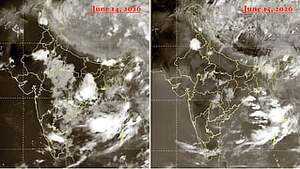
Satellite imagery and meteorological data are flashing warning signals across India. The India Meteorological Department (IMD) and global weather agencies report that the southwest monsoon has weakened sharply across large parts of the country. Meteorologists attribute the slowdown to changes in upper-atmospheric wind patterns that have triggered a significant ‘monsoon pause’ just as the crucial kharif sowing season begins.
Past the half-way mark in June, the air over the Indian subcontinent carries a weight heavier than the usual pre-monsoon humidity. The United States National Oceanic and Atmospheric Administration (NOAA) and the IMD have confirmed what many feared: El Niño has officially begun. Scientists are warning that it could evolve into a powerful, even ‘super’ El Niño event later this year.
For India, the implications are profound. The Indian summer monsoon (ISM) contributes nearly 82 per cent of our annual rainfall. Even a deviation of 10-20 per cent can disrupt agriculture, damage rural livelihoods and slow economic growth.
This year, the IMD has projected a below-normal monsoon at 90 per cent of the long-period average. The Centre has already placed 150-200 vulnerable districts under close watch, fearing widespread agricultural distress if rainfall deficits deepen during August and September.
Yet the crisis confronting India is larger than a single failed monsoon. The 2026 El Niño is a stark reminder that the era of predictable monsoons is ending. The country is no longer dealing with a temporary weather shock; it is navigating what many experts describe as a permanent condition of water bankruptcy.
The climate crisis is converging with a deeper ecological emergency. The United Nations has warned that many parts of the world are entering an era of ‘Global Water Bankruptcy’, where groundwater reserves and soil moisture are being depleted faster than nature can replenish them.
When tap water remains a pipe dreamFew countries illustrate this challenge more vividly than India. Home to nearly 17 per cent of the world’s population with only four per cent of its freshwater resources, India has become one of the most water-stressed nations on earth.
According to the Central Water Commission, India possesses around 1,123 billion cubic metres (BCM) of utilisable water resources. Of this, 690 BCM comes from surface water and 433 BCM from groundwater. Agriculture consumes nearly 80 per cent of these resources, while domestic and industrial users share the remaining 20 per cent. The numbers reveal the scale of dependency. Agriculture is not merely a consumer of water; it is the principal debtor in India’s water economy.
The most alarming aspect of India’s water crisis is invisible.
Groundwater consumption has increased by nearly 500 per cent over the past five decades. As a result, groundwater levels have fallen by more than eight metres on average since the 1980s.
Perhaps the most dramatic example is Punjab. Once celebrated as the cradle of the Green Revolution, the state has witnessed a continuous decline of its water table. Bet-ween 1973 and 2016, the average ground-water depth increased from 4.8 metres below ground level to 14.6 metres. More than three-fourths of the state’s area is now categorised as overexploited.
This depletion is slow, almost imperceptible, but devastating. Unlike floods that arrive suddenly, groundwater exhaustion unfolds silently beneath the surface, eroding the ecological foundations of agriculture year after year.
The irony is that many of the policies that once guaranteed India’s food security are now contributing to its water insecurity.
Research increasingly suggests that government procurement policies and minimum support prices (MSP) have created an unintended ecological trap. By guaranteeing markets for rice and wheat, governments encouraged farmers to cultivate crops that demand enormous quantities of water.
In Punjab, each doubling of rice procurement has been linked to a 25 per cent increase in rice cultivation, which in turn accelerated groundwater depletion.
Of vanishing lakes, concrete jungles and thirsty citiesToday, four crops — rice, sugarcane, wheat and cotton — consume nearly 700 BCM of water annually, equivalent to almost 60 per cent of India’s utilisable water resources. Rice alone requires roughly 2,500 litres of water to produce a single kilo.
The story is not confined to Punjab. In Madhya Pradesh, government wheat procurement expanded dramatically after 2008. Wheat procurement jumped from just 57,000 tonnes in 2007 to 2.4 million tonnes in 2008 after the state introduced procurement bonuses. Farmers responded rationally by expanding wheat cultivation.
The consequences were soon felt under the ground. Irrigated wheat acreage expanded rapidly, dependence on tubewells increased, shallow wells began drying up, and farmers were forced to invest in deeper borewells. The state’s hard-rock aquifers, already vulnerable, came under mounting stress.
Yet scarcity is not the only manifestation of India’s water crisis.
In parts of Haryana, particularly the Rohtak-Jhajjar belt, farmers face the opposite problem: too much water trapped in the wrong place.
Villages such as Bhalaut are grappling with chronic waterlogging and soil salinity. Decades of canal irrigation, poor drainage and paddy cultivation have raised shallow water tables. Farmers describe a sub-surface layer known locally as the ‘chawa’ that brings saline water upward through capillary action.
The result is an agricultural paradox. While much of India is running out of water, these farmers are watching fertile land become unproductive because it cannot drain excess water.
For them, the solution is not more irrigation but deep drainage systems capable of ‘breaking the chawa’ and carrying away stagnant saline water.
Their experience highlights a critical lesson: India’s water crisis is not uniform. It varies dramatically across landscapes, requiring solutions tailored to local ecological realities.
Faced with a potentially weak monsoon, the Union agriculture ministry has ordered all states to update decade-old district contingency plans. These plans recommend shifts toward drought-tolerant crops such as pearl millet, pigeon pea and sorghum if rainfall deficits worsen.
However, many farmers remain sceptical.
“It’s easier said than done,” says a farmer-leader from western Uttar Pradesh. “There is hardly any assured market for these crops. Farmers cannot grow something they cannot sell.”
The concern is valid. Agriculture has already become a low-margin, high-risk occupation. Asking farmers to abandon familiar crops without creating procurement systems and markets for alternatives simply transfers risk from the state to the cultivator.
Experts argue that resilience requires far more than emergency advisories. First, India must move beyond simplistic measures of water use. Policy-makers need to focus on consumptive use — how much water crops actually consume — rather than merely measuring how much water is applied. Technologies such as drip irrigation can save water at the farm level but sometimes increase overall water depletion if they encourage more intensive cultivation.
Second, procurement and subsidy policies must be redesigned to reward crop diversification and ecological sustainability rather than merely production volumes.
Third, investments in watershed restoration, groundwater recharge, rainwater harvesting and traditional tank systems must become central to rural development strategies.
Most importantly, policymaking must become genuinely farmer-centric. Farmers understand their local ecosystems better than distant bureaucracies. Their experiences with drought, waterlogging, soil degradation and market failures should shape future water and agricultural policies.
The challenge before India is no longer simply producing more food. It is producing food without exhausting the ecological foundations on which agriculture depends.
As the clouds gather uncertainly over the subcontinent this year, one reality is becoming impossible to ignore. India’s future food security will depend not only on the monsoon above, but on the water that remains beneath its soil. The question is whether policymakers will act before that hidden reserve is exhausted beyond recovery.
Contact to : xlf550402@gmail.com
Copyright © boyuanhulian 2020 - 2023. All Right Reserved.