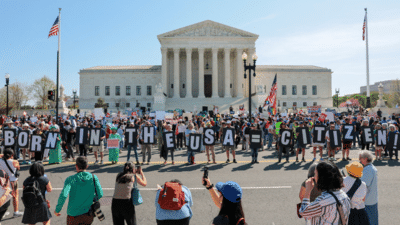
Washington: The US Supreme Court has rejected President Donald Trump’s attempt to limit birthright citizenship, delivering a major legal setback to one of his key immigration policies.
In a 6-3 ruling on Tuesday, the court upheld a lower court’s decision that blocked Trump’s executive order directing federal agencies not to recognise the citizenship of children born in the United States if neither parent is a US citizen or a lawful permanent resident.
US Supreme Court blocks Trump’s bid to restrict birthright citizenship
The legal challenge centred on the Citizenship Clause of the 14th Amendment to the US Constitution, which states that people born in the United States are citizens of the country.
Those challenging Trump’s order argued that the policy violated the Constitution and contradicted the Supreme Court’s landmark 1898 ruling in United States v. Wong Kim Ark, which confirmed birthright citizenship for children born on US soil.
Writing for the majority, Chief Justice John Roberts said, “Not surprisingly, then, in the 128 years since, we have repeatedly understood the rule of Wong Kim Ark to guarantee citizenship to all children born in the United States and subject to its power. We see no reason to depart from that view today.”
Trump’s immigration push
Trump signed the executive order on his first day back in office as part of his wider crackdown on legal and illegal immigration.
His administration argued that the phrase “subject to the jurisdiction thereof” in the 14th Amendment should not automatically include children of undocumented immigrants or those whose parents were in the country temporarily on visas.
The administration also claimed that unrestricted birthright citizenship had encouraged “birth tourism”, although government lawyers acknowledged there were no precise figures on its scale.
Experts had estimated that Trump’s order could have affected the legal status of up to 250,000 babies born in the US each year.
Chief Justice Roberts also rejected the administration’s interpretation of the Constitution, writing there was “scant evidence” to support its “dramatically revisionist view” of the Citizenship Clause.
The ruling marks the second major defeat for Trump before the Supreme Court this year, after the court struck down his global tariff policy in February.
The decision leaves birthright citizenship unchanged, preserving a constitutional right that has been recognised in the United States for more than 125 years.
Contact to : xlf550402@gmail.com
Copyright © boyuanhulian 2020 - 2023. All Right Reserved.