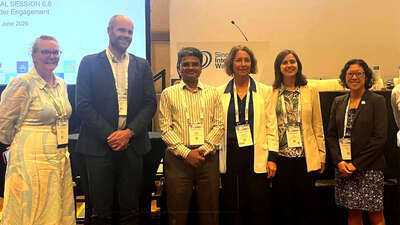
For over a decade, a Nashik-based grassroots group has been proving that solving rural India’s water crisis is less about pouring money into new concrete engineering and more about getting communities to own the assets. This month, that local philosophy took center stage at the Singapore International Water Week (SIWW) 2026.
Pramod Gaikwad, founder of the Social Networking Forum (SNF), presented the organization’s specialized rural blueprint before an audience of international policymakers, researchers, and utility heads at the Sands Expo and Convention Centre.
Titled "Water as a Catalyst: A Nexus-Based Model for Empowerment of Tribal Communities in Rural India," Gaikwad’s paper was selected for an oral presentation during a technical session on stakeholder engagement. He shared the stage with water experts presenting regional case studies from the UK, the US, Australia, and Spain.
Rather than speaking in abstract policy terms, Gaikwad grounded his presentation in real-world data from Maharashtra 's tribal belt. A central point of interest for global delegates was SNF’s strategy of reviving abandoned infrastructure.
Gaikwad detailed a specific case study involving a cluster of tribal villages where a major government-funded drinking water project had sat completely idle despite significant financial investment. Instead of requesting a new budget to build something from scratch, SNF worked with the villagers to repair, retrofit, and reactivate the existing network. The entire system was then integrated into a community-led model managed directly by the local Gram Panchayat .
The presentation challenged the global water sector to look beyond pipelines and meters. Gaikwad showed clear links between water proximity and social mobility: when clean water is made accessible at the village level, childhood school attendance—particularly among girls who bear the burden of walking for water—surges. The data also tied the interventions to a drop in water-borne diseases and an uptick in small-scale rural economic activities.
According to SNF, this community-driven approach has already been deployed across 36 tribal villages, providing reliable drinking water to over 70,000 residents. The group’s broader initiatives spanning health, nutrition, and education have reached a population of over 200,000 across Maharashtra.
The presentation marks the first time a grassroots initiative from rural Maharashtra has broken through to the SIWW platform, sparking post-session discussions with delegates from other developing regions facing identical geographic and resource constraints.
"The global water community is realizing that the most resilient systems are the ones maintained by the people who drink from them," Gaikwad said following the panel. "Bringing the lived experiences of our tribal communities to an international forum like Singapore wasn't just about sharing our success—it was about showing that hyper-local, low-cost Indian models have global relevance."
Contact to : xlf550402@gmail.com
Copyright © boyuanhulian 2020 - 2023. All Right Reserved.