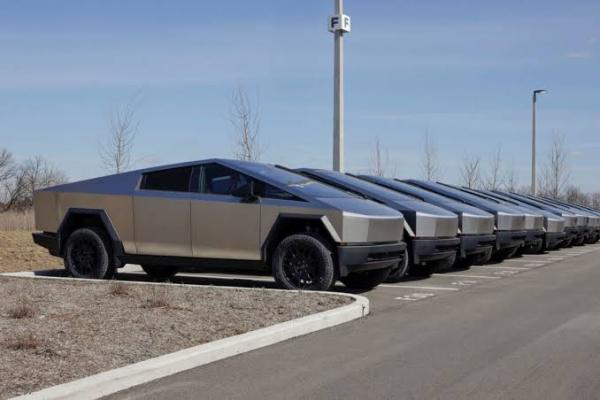
Tesla’s Cybertruck was once expected to redefine the pickup truck segment. Its futuristic styling, stainless steel body, and bold promises helped it become one of the most talked-about vehicle launches in recent history. But less than a year after reaching customers in meaningful numbers, the narrative has shifted dramatically.
Falling demand, rising inventories, and repeated price adjustments have led many industry observers to compare the Cybertruck with one of the automotive world’s most famous commercial disappointments: the Ford Edsel.
While the comparison may seem dramatic, it reflects growing concerns about whether Tesla’s unconventional pickup can achieve the mainstream success the company originally envisioned.
A Product That Struggled to Meet Expectations
When Tesla unveiled the Cybertruck in 2019, CEO Elon Musk described it as a vehicle unlike anything on the road. Millions of reservation holders appeared to validate the excitement, creating expectations of massive production volumes.
Reality has proven far more complicated.
The production version arrived years later than originally planned, carrying a significantly higher price tag than early estimates. At the same time, several promised specifications evolved as the vehicle entered mass production, leaving some potential buyers questioning its value proposition.
Instead of seeing waiting lists stretch endlessly, Tesla has increasingly relied on incentives, financing offers, and inventory availability to attract customers.
The contrast between initial enthusiasm and current market performance has become impossible to ignore.
Why the Cybertruck Faces a Tough Market
Unlike conventional pickup buyers, Cybertruck customers are embracing one of the most unconventional vehicle designs ever produced.
Its sharp geometric styling attracts attention everywhere it goes, but that same design also limits its appeal among traditional truck buyers who prioritize practicality, familiarity, and versatility.
Pricing has also become a challenge.
Many consumers who expected a more affordable electric pickup discovered that the Cybertruck competes with premium luxury trucks instead. Higher interest rates and slowing EV demand have further complicated purchasing decisions.
Competition has intensified as well. Rivals now offer electric pickups with more familiar styling, established dealer networks, and features tailored toward everyday work use rather than headline-grabbing design.
For many buyers, functionality continues to outweigh novelty.
The Ford Edsel Comparison
Mentioning the Ford Edsel immediately evokes one of the automotive industry’s biggest marketing lessons.
Introduced in 1957 after enormous hype, the Edsel promised innovation but failed to resonate with buyers. Production ended after only a few years, and the name eventually became synonymous with products that generated tremendous expectations but disappointed commercially.
The Cybertruck is far from becoming another Edsel in a literal sense. Tesla remains one of the world’s most valuable automakers, and the pickup has successfully demonstrated several engineering innovations.
However, the comparison focuses less on technology and more on expectations.
Both vehicles entered the market surrounded by unprecedented publicity. Both attracted enormous curiosity before launch. And both struggled to translate that attention into sustained mass-market demand.
That parallel has become increasingly difficult for analysts to ignore.
Tesla Still Has Options
Despite slowing sales, writing off the Cybertruck would be premature.
Tesla has repeatedly demonstrated an ability to adapt its products through software updates, pricing adjustments, and manufacturing improvements. The company has previously revived slowing demand for other models through aggressive incentives and expanded financing options.
Introducing lower-priced variants could also broaden the Cybertruck’s customer base. Many reservation holders who initially expressed interest may reconsider if pricing becomes more accessible.
International expansion presents another opportunity, although regulatory challenges and the vehicle’s size could limit its reach in several global markets.
More Than Just One Vehicle
The Cybertruck’s performance carries broader implications for Tesla.
For years, the company has built its reputation on introducing products that reshape entire vehicle categories. If the Cybertruck ultimately remains a niche product rather than a high-volume bestseller, investors and competitors alike may begin questioning whether Tesla can continue repeating that formula.
The slowdown also comes as the global electric vehicle market becomes increasingly competitive. Legacy manufacturers and new entrants are launching fresh models across multiple price segments, giving consumers more choices than ever before.
In such an environment, standing out is no longer enough. Delivering the right combination of affordability, practicality, and reliability has become equally important.
The Road Ahead
The Cybertruck remains one of the most recognizable vehicles on the road, and it continues to generate conversation wherever it appears. Yet public attention does not automatically translate into long-term sales success.
Whether the vehicle ultimately becomes a niche icon or evolves into a stronger commercial performer will depend on Tesla’s ability to adapt to changing customer expectations.
For now, comparisons with the Ford Edsel highlight an uncomfortable reality: even the most ambitious automotive ideas must ultimately succeed where it matters most, earning sustained demand from buyers long after the excitement of launch day has faded.
Contact to : xlf550402@gmail.com
Copyright © boyuanhulian 2020 - 2023. All Right Reserved.