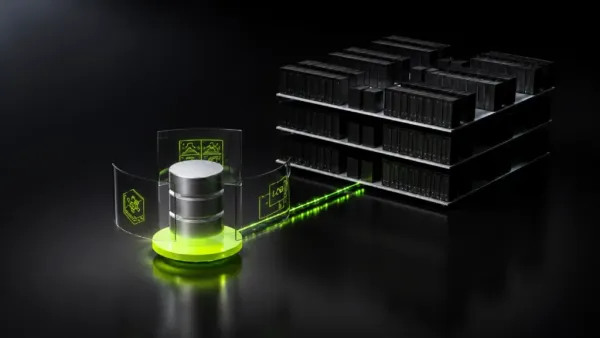
If you’ve been assuming storage is the boring, solved part of building AI infrastructure, NVIDIA just made the case that it isn’t. The company is opening one of its previously closed AI infrastructure layers.
At the Future of Memory and Storage conference (FMS) 2026 in Santa Clara on August 4, NVIDIA announced it’s open-sourcing its cuFile APIs, along with the vertically integrated storage software stack built underneath them, confirmed directly on NVIDIA’s own blog and corroborated by SiliconANGLE, StorageReview, and Futurum Group.
The move targets one of AI’s biggest hidden challenges: letting GPUs read from and write to storage directly, bypassing the CPU entirely, and hands control of the underlying code to a cross-vendor group rather than keeping it exclusive to NVIDIA.
The announcement wasn’t just a code release. NVIDIA paired it with a new industry coalition, a fresh security-focused framework, and updated benchmark claims for its BlueField-4 storage processors, positioning the whole package as infrastructure built specifically for what the company calls “AI factories.”
What Actually Got Open-Sourced
cuFile itself isn’t new technology. It first reached general availability back in July 2021 alongside CUDA Toolkit 11.4 as part of the NVIDIA GPUDirect Storage platform and works by using direct memory access to move data from NVMe drives straight into GPU memory, cutting out the software layer that would otherwise have to shuttle data through the CPU first.
NVIDIA Targets the Hidden Problem Behind AI Scaling
What’s new is where the code lives: NVIDIA has moved cuFile and its supporting stack to a new, neutral GitHub organization, with Google, Intel, Meta, and NVIDIA named as the project’s inaugural maintainers. StorageReview specifically noted this marks a departure from NVIDIA’s usual approach of keeping this layer bundled inside CUDA, its proprietary compute platform.
The practical problem cuFile addresses is what the industry calls “GPU starvation,” where expensive, fast GPUs sit idle waiting for data to arrive because the storage pipeline feeding them can’t keep pace. As AI models, context windows, and agentic workloads generate and consume increasingly large datasets, that bottleneck becomes more costly the more GPU capacity a company has deployed.
NVIDIA Introduces SCADA and the Push for Industry Standards
Alongside cuFile, NVIDIA introduced SCADA, a data access framework built specifically for coordinating storage requests across massively parallel GPU workloads, designed to balance faster access against the security controls large-scale AI deployments require.
NVIDIA paired this with Storage-Next, an industry initiative bringing together more than 40 storage and flash vendors, including DDN, KIOXIA, and Micron, aimed at standardizing how GPU-driven storage behavior works across different hardware rather than leaving each vendor to build against NVIDIA’s stack independently.
That coalition-building is arguably the more strategic part of this announcement. By publishing the interface GPUs use to reach storage, open-sourcing its implementation, and organizing dozens of vendors around shared standards, NVIDIA is positioning itself to define how the entire industry’s storage layer talks to GPUs, even as it opens up the code itself.
Vera BlueField-4 STX and the Performance Numbers
NVIDIA tied the software announcements to its Vera BlueField-4 STX hardware, a rack-scale storage architecture combining its Vera Rubin platform, BlueField-4 storage processors, and Spectrum-X Ethernet networking.
The company cited an internal benchmark showing the Vera CPU inside BlueField-4 STX delivered up to 3.21 times the throughput of a comparable x86 CPU on a two-stage compression-and-encryption pipeline, tasks StorageReview noted currently consume significant x86 core capacity inside conventional storage controllers.
NVIDIA’s DOCA software framework enforces security policy throughout that data path, while a new CMX Context Memory Storage tier pools flash behind BlueField-4 as a shared cache layer for long-context AI inference.
Partner systems built on this architecture, from vendors including DDN, Dell, HPE, IBM, VAST Data, and WEKA, are expected to ship in the second half of 2026.
Why This Matters for NVIDIA’s Broader Position
NVIDIA’s data center business posted $75.2 billion in revenue for its most recent fiscal quarter, with that segment driving more than 92% of the company’s revenue growth.
Extending its influence into storage, an adjacent layer of AI infrastructure it doesn’t currently dominate the way it does GPU compute, gives NVIDIA a stake in a part of the stack that’s becoming a genuine bottleneck as AI systems scale.
Opening the interface while organizing the vendor ecosystem around it is a strategy that expands the addressable market for NVIDIA-compatible storage hardware, even as the code itself becomes freely available.
What to Watch Next
The clearest signal to track is how quickly Storage-Next’s 40-plus vendor coalition converges on shared implementation standards, since that determines whether this genuinely opens the market to competing storage architectures or simply extends NVIDIA’s platform influence into a new layer under an open-source label.
The second-half 2026 arrival of partner systems built on BlueField-4 STX will also be the first real test of whether NVIDIA’s benchmark claims hold up in production deployments rather than internal testing.
Contact to : xlf550402@gmail.com
Copyright © boyuanhulian 2020 - 2023. All Right Reserved.