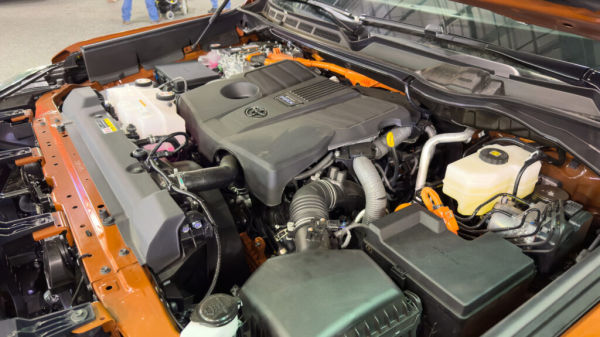
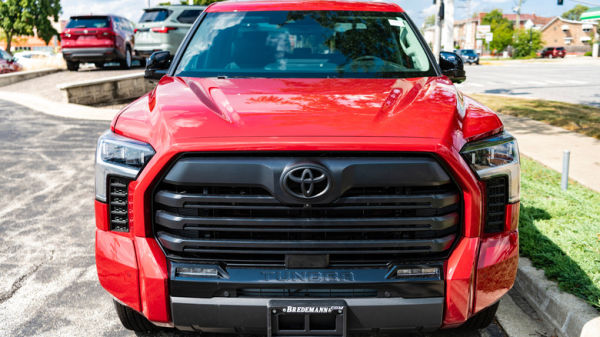
The Toyota Tundra is one of the automaker’s most well-known vehicles and a recognizable full-size pickup truck. But the Tundra has been the subject of recalls over the past couple of years, to an issue with manufacturing debris that can damage the engine’s main bearings. Now, dealership technicians are using a unique way to find out whether an affected engine needs to be replaced, and it involves a hammer.
The Tundras in question are certain 2022-2024 models with the V35A twin-turbo V6 engine. The hammer is used as part of a test officially called the V35A Crank Bearing Inspection, and it begins with an oil change. The accessory belts are then removed and the crankshaft is set to the specified position. An accelerometer is then attached to the crankshaft bolt. Using a plastic hammer, a technician hits the crankshaft pulley at the 3 o’clock position, creating an impact that the accelerometer measures as the engine responds, while computer software checks the quality of each hit.
Toyota requires three usable measurements for the test and the collected information, along with the test results, is sent to the company’s cloud system. The test will yield either an “OK” or a “Replace” result. As of this writing, Toyota hasn’t explained which aspects of the vibration data cause an engine to pass or fail. But the hammer method is perhaps a more practical way to evaluate the engine’s status without completely disassembling it.
The science behind Toyota’s unusual engine test
Just dance/Shutterstock
The ongoing concern with Toyota’s V35A engine’s main bearings is due to the important role these components have inside the engine. Engine bearings provide a controlled surface for the crankshaft to rotate against, with engine oil being used to help keep the two components separated during engine operation. If that separation is interrupted, friction can generate heat as a result. If enough heat is produced over a period of time, both the bearing and crankshaft can become worn, or even damaged.
The hammer test that’s being used for some third-gen Toyota Tundra models isn’t exactly a new science. In fact, vibration analysis is a common method for evaluating the condition of mechanical equipment, including vehicles. When a machine or component is subjected to a force, the resulting vibration can reveal information about its condition. This is important, because certain mechanical faults can produce identifiable vibration patterns.
But vibration testing can also reveal more than just how much an engine component moves. Engineers can actually break down the resulting vibration by specific factors like frequency and amplitude. This can help identify specific characteristics of a mechanical problem. So when automotive testing uses these techniques to analyze engine vibration, engineers get better insight into what’s happening inside a vehicle’s mechanical systems.