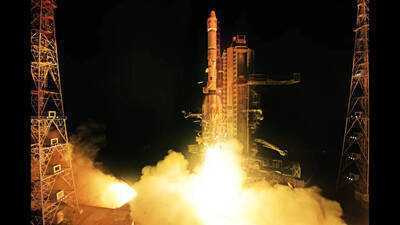
BENGALURU: Isro , which saw the first successful mission of the year on Sept 4, is gearing up for another launch, while preparations for at least three other missions are being carried out parallelly. The space agency is targeting the next launch, the NVS-03 navigation satellite onboard a GSLV-Mk2 rocket, between Oct 15 and 20, multiple sources confirmed to TOI.
Sources said the stacking of the first stage of the GSLV-Mk2 has already been completed. “The launch campaign began on Sept 14 and we are confident of completing it within a month,” one source said, while another added that all efforts were on for a launch on Oct 15.
Given that NVS-03, as reported by TOI in Aug, is ready and already at the spaceport in Sriharikota means there will be no wait time for the satellite. NVS-03 along with Gisat-1A were two strategic satellites that were sitting at the spaceport awaiting govt approval for launch, which came in September.
The NVS-03 is the next satellite in India’s second-generation NavIC navigation constellation, and its launch assumes importance in the backdrop of an ailing NavIC programme. Union minister Jitendra Singh had recently conceded: “After completion of mission life (10 years) of IRNSS-1F, presently the NavIC constellation has three satellites — IRNSS-1B, IRNSS-1I and NVS-01 — for providing PNT [position, navigation and timing] services. To provide basic positioning service, a minimum of four operational satellites are required in orbit.”
“...Hence, the NavIC constellation cannot provide standalone positioning service, however timing service is functional… The next NavIC satellite NVS-03 is ready for launch and two more satellites NVS-04 & NVS-05 are in the advanced stage of realisation,” he added.
That Isro’s previous mission to launch a navigation satellite, the NVS-02, launched on Jan 29, 2025 failed, makes the Oct mission key. NVS-02, launched aboard GSLV-F15, was injected into an elliptical transfer orbit of 170 x 37,785 km with an inclination of 20.8°.
After the spacecraft separated from the launch vehicle, the satellite carried out a sequence of autonomous operations, including deployment of its solar panels and stabilisation of its orientation to ensure power generation. However, the planned orbit-raising operations from the elliptical transfer orbit to the designated circular orbit could not be executed.
Later, the apex committee that investigated why the NVS-02 spacecraft failed, traced the anomaly to the spacecraft’s pyro system.
According to the findings, the drive signal did not reach the pyro valve in the oxidiser line of the engine meant for orbit-raising manoeuvres. As a result, the engine could not be fired to shift the satellite from its transfer orbit into its final circular orbit.
The panel concluded that the most likely cause was the disengagement of at least one contact in each of the main and redundant connector paths. Despite redundancy built into the system, the electrical command required to trigger the pyro valve did not get through.
Isro had said that the committee had recommended a set of corrective measures to enhance redundancy and improve the reliability of pyro system operations in future missions. These recommendations have already been implemented.
Contact to : xlf550402@gmail.com
Copyright © boyuanhulian 2020 - 2023. All Right Reserved.