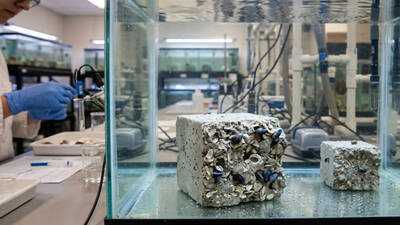
Seafood markets and restaurants consume many oysters, and they typically throw the shells away. For every kilogramme of oysters and scallops consumed, between 370 and 700 grammes of shell remain, most of which is disposed of or buried. Meanwhile, an estimated have been lost, and the young shellfish that could rebuild them need a solid surface to cling to. University of Melbourne researchers tested whether the two problems could help solve each other. Mussel larvae settled on porous concrete built from crushed oyster shells much more easily than on regular mortar, according to a study published in early 2024.
The notion is a perfect fit along Australia’s southern coast, where reef rehabilitation is already well underway. has recycled more than 510 tonnes of shells through its Shuck Don’t Chuck program and has rehabilitated 49 reef areas in Port Phillip Bay since 2017. The same system that gathers surplus food from Victorian restaurants and vendors provided the shells for the Melbourne trial.
Why Reefs Need a Strong Foundation
Young mussels require a solid, robust surface to settle on. Loose piles of shell work well in still water, but in harsher conditions they can shift before anything has a chance to settle on them. Concrete is a common choice for reef units since it is strong, inexpensive and easy to mould. The difficulty is that standard Portland cement concrete has a pH of around 13, and research shows it takes at least six months in seawater for the surface of concrete to get anywhere near the pH of the sea itself. In the meantime, other areas that would have been taken over by other species can be invaded by alkaline-tolerant invertebrates, such as barnacles.
More marine-life friendly concrete would be an advantage from the outset. Shells have a second benefit in that they can replace some of the mined stone and gravel used in concrete. Aggregates are the most mined solid material on the globe. That was the self-imposed brief of the Melbourne squad.
What the team made
The Madhuwanthi Rupasinghe, Rackel San Nicolas, Brendan Lanham and Rebecca Morris in Construction and Building Materials. They ground and sieved shells to between 4.75 and 19 millimetres and utilised them instead of all the standard coarse stone. Three recipes were attempted. One used conventional cement mixed with river sand. The other two used 75 per cent pulverised granulated blast furnace slag, a by-product of iron manufacturing, in place of cement, and mixed it with river sand or sea sand from Lakes Entrance in Victoria.
The shell concrete was light. The study found it was pervious, meaning water can travel through it, with a density of about 1,250 kilogrammes per cubic metre, almost half the roughly 2,450 of standard concrete. Lighter units would cost less to ship and be easier to deploy on the seafloor. The slag added strength too. After 28 days, the slag and river sand mix was 14 per cent stronger than the cement-based shell concrete, rising to 20 per cent after 56 days, and the slag and sea sand versions were 16 and 24 per cent stronger at the same ages. Surface pH was also lower, at 10.14 for the cement mortar against 8.83 and 9.11 for the slag variants, closer to seawater's roughly 8.1. As the mussel tests showed, though, pH turned out not to be what mattered.
The most telling test was with blue mussels. About 2,500 of these were placed in each of six aquariums for three days, with a sample of each mix and ordinary mortar controls with no shell in each tank. Larvae attached in far greater quantities to shell concrete than controls, with the number more than twice for two of the three recipes. Notably, pH made no measurable difference to mussel settlement; the authors credit the rough, pitted surface that crushed shells produce. The study did not test whether lower pH matters for other species. 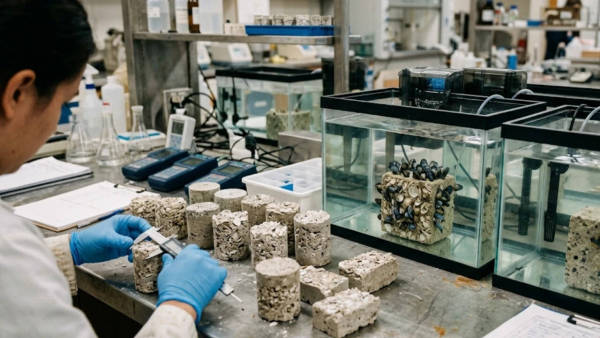
What is left to prove
The experiments were done in a laboratory, over three days, with one species, and other species may prefer different surfaces. Pervious concrete is also generally weaker than dense concrete. Its ultrasonic pulse velocity, a measure of how solid the material is inside, was around 800 metres per second, compared to a normal 3,000 to 4,500 for ordinary concrete, which reflects its many pores. The authors stress that stability in real waves will have to be confirmed in the field, and resistance to chloride and sulphate still needs testing. They also recommend around 56 days of air curing before the units are placed in the sea, as carbonation reduces the surface pH.
Demand for reef-building material is unlikely to fade. The Nature Conservancy Australia said its Reef Builder programme, a $20 million partnership with the the Australian Government delivered from 2021 to 2023, restoring more than 40 hectares of shellfish reef across 13 sites. If shell concrete passes sea trials, reef builders would have a lighter, stronger and shell-rich option, and a restaurant trash problem would become a habitat. For now, it remains a promising lab finding.
Contact to : xlf550402@gmail.com
Copyright © boyuanhulian 2020 - 2023. All Right Reserved.