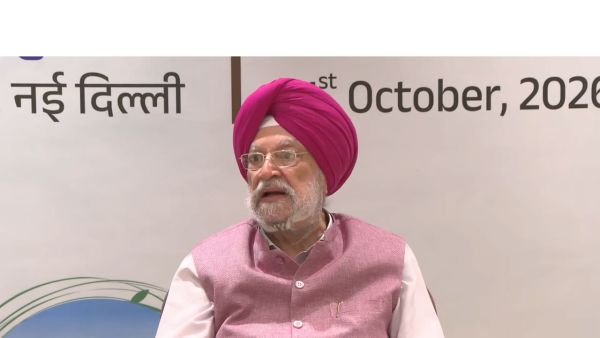
Petroleum Minister Hardeep Singh Puri highlighted the imperative of using domestic biomass to counter global gas volatility and raise the gas mix to 15%. He detailed financial support for CBG plants under the GOBARdhan Yojana to boost domestic production.
Addressing a news conference in Delhi on Thursday, Petroleum and Natural Gas Minister Hardeep Singh Puri highlighted the utmost importance of utilizing domestic biomass to navigate the global gas situation. “The challenge today arises from global volatility. The question then is, how will the global landscape evolve? I have reiterated here today: it is an absolute imperative for us to utilise domestic biomass to the greatest extent possible.”
Puri stated that domestic resource utilisation is vital to protecting the domestic market from global volatility and driving the country’s gas mix upward from the current 6 to 7 per cent toward a 15 per cent target.
The Minister noted that relying on external sources remains costly, observing that natural gas imports stood at USD 13 billion in the 2025–26 financial year. With the economy recording 7.8 per cent growth in the last quarter, three times the global average, the minister underlined that harnessing indigenous bio-resources remains non-negotiable.
GOBARdhan Yojana: A New Ecosystem
“If I were in your place, this question would arise in my mind: why has this new GOBARdhan Yojana been formed? Why will this be successful? And what is the difference between what you were doing before and what we are doing now?” Puri added.
“So in that, I’ve mentioned a couple of new things, which I think are a major innovation for me. I think, at this time, other than success, we don't have any other choice. That's why the government has created such a plan by which the central government and the state government together, created a new ecosystem. Through which, those who will come to install the CBG plant and want to install it, will receive assistance for capital expenditure.”
Financial Support and Incentives
Elaborating on the financial architecture, Puri detailed the direct support mechanisms earmarked for plant developers.
“The data I used during my speech, which we are following, suggests that even for capital expenditure, you could get up to Rs 2 crore per ton per day (TPD), Rs 2 crore. There is a credit guarantee as well. For MSMEs, if it's normally Rs 20 crore and if you are a woman-led enterprise, you will have, instead of Rs 20 crore, a guarantee of Rs 25 crore,” he stated.
Puri also highlighted that this is the most important thing needed at this time. “There is guaranteed offtake. Our entities will buy those. Offtake will be on terms which are more which are preferable to and higher than global terms,” he said.
Progress and Future Targets
Detailing the physical progress of the initiative, Puri stated that under the previous framework, 217 plants with a commissioned capacity of 1,700 TPD became operational, while more than 330 plants with 2,700 TPD capacity are currently under construction. The minister pointed out that the current average annual production stands at 0.4 MMSCMD, with a target to scale it ten times to 5 MMSCMD and achieve a near-future capacity of 4 to 6 MMTPA. Over 90 commissioned plants operate across the top three states of Uttar Pradesh, Maharashtra, and Gujarat, with 20 plants connected to pipelines.
Addressing the national pipeline grid, Puri highlighted that the network expanded from 14,000 kilometres in 2014 to between 27,000 and 28,000 kilometres at present, tracking steadily toward the 35,000-kilometre target.
(Except for the headline, this story has not been edited by Asianet Newsable English staff and is published from a syndicated feed.)Contact to : xlf550402@gmail.com
Copyright © boyuanhulian 2020 - 2023. All Right Reserved.