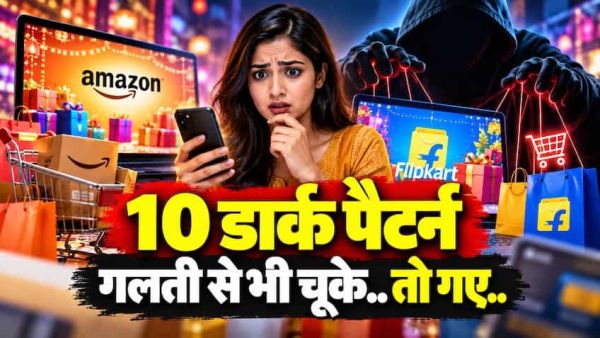
As soon as the festive season starts, a grand celebration of discounts, bumper cashback and flash sales starts on e-commerce platforms. Any common consumer gets greedy after seeing huge discounts ranging from 50 to 80 percent. But behind this golden glare, a very subtle and vicious digital technology works, which in technical and legal language is called ‘Dark Patterns’. Dark patterns are deceptive user interface (UI) design and psychological tricks that platforms use to deliberately coerce customers into making decisions they would never make under normal circumstances.
The Central Consumer Protection Authority (CCPA) and the Ministry of Consumer Affairs have issued strict guidelines regarding these unethical practices adopted by online companies and have also banned many. Despite this, during festive sales, hidden algorithms of companies take advantage of the fear, haste and greed of customers to break into their bank accounts. If you are also shopping online, then it is very important for you to recognize and avoid these 10 vicious dark patterns.
False Urgency and Fake Timer: When you’re viewing a product, a ticking red countdown timer appears on the screen, such as “Only 5 minutes left until offer ends!” or “Only 2 pieces left in stock!”. In most cases this is completely fake data, programmed to create ‘FOMO’ (fear of missing out) in the user’s mind so that they order immediately without thinking.
Basket Sneaking: This is the most common and hidden maneuver. When you reach the checkout page, an additional item is automatically added to the item you selected—such as a donation of ₹49, an extended warranty cover of ₹99, delivery insurance or a small sachet. Unless you look closely at each item on the bill, these extra charges quietly add up to your total bill.
Drip Pricing Game: The price of a gadget or garment is shown as ₹999 on search results and product pages. The customer is happy and puts it in the cart. But as he moves towards the final payment page, a number of hidden charges slowly start dripping in—convenience fees, packaging charges, pick-up handling charges and surcharges. An item of ₹999 becomes worth ₹1,350 at the time of final payment.
Confirm Shaming: When you try to cancel an expensive subscription, insurance or warranty plan, the cancellation button is written with sentences that make you feel emotionally guilty. For example, “No, I don’t care about my safety” or “No, I don’t want to save money”. Due to this mental pressure, many customers hesitate in taking the service.
Subscription Trap and Roach Motel (Roach Motel / Subscription Trap): Getting a membership or Prime subscription to a service is as easy as one click, but when you want to cancel or unsubscribe, the option is buried deep within several sub-menus and settings within the app. The customer eventually gets frustrated and leaves the subscription running and money keeps getting deducted from his account every month.
Hidden Advertisements and Blended Ads: Many times when you search for a branded or genuine product, it is not the same product but a similar sponsored or substandard third-party product that is shown at the top in such a way that it looks like the real search result. In a hurry, the customer clicks on it and buys a substandard product.
Forced Bundling: Often when buying a smartphone, laptop or TV, the company bundles a charger adapter, cable, protective case or OTT subscription with the main product. The rule should be that the customer should be able to buy only the main item, but the system does not allow him to do so and charges extra money for the entire bundle.
Interface Interference and Color Illusion: The customer’s eyes are deceived through designing in the user interface. Options that benefit the company (such as ‘Pay Now’ or ‘Subscribe’) are shown as large, bright, green buttons; Whereas the cancel, back or skip buttons are hidden in the corner in a blurry, light gray color so that it is not easily visible to the user.
Nagging means repeatedly troubling (Nagging): When you’re browsing anything on the app, there are frequent pop-ups on the screen forcing you to take a credit card, purchase a premium pass, or give permission for your location and contacts. Despite repeated refusals, this pop-up keeps bothering you until you tap the wrong button in irritation.
Bait and Switch: The discount banner boasts of flat 70% off or product for ₹1 in big letters. When the customer gets excited and clicks on it, the item inside is either ‘out of stock’ or the offer has a long web of terms and conditions which are impossible to fulfill. Its sole purpose is to draw the customer to your website or app.
To save your hard-earned money during online sales, it is important that you do not rush while shopping. After visiting any payment page, check the price breakdown of the bill completely before pressing the final ‘Pay’ button. Check if any unwanted handling charge, tip or insurance boxes are pre-ticked. If so, untick that checkbox immediately.
Use price tracker extensions and tools to analyze product pricing to see what the actual price of an item was a week before the sale. Many companies increase the price just before the start of the sale and then pretend to have a 50% discount on it.
If you are defrauded by any e-commerce platform or seller through dark patterns, you can directly lodge a complaint on the National Consumer Helpline (NCH) portal of the Department of Consumer Affairs, Government of India. For this, one can call toll-free number 1915 or upload written evidence along with screenshots on ‘UMANG’ app and consumer helpline website. CCPA is taking action in these cases against misleading advertisements and unfair trade practices by imposing heavy fines on companies and even canceling licenses. Only wisdom and vigilance can save you from unnecessary financial loss in this festive sale.
Contact to : xlf550402@gmail.com
Copyright © boyuanhulian 2020 - 2023. All Right Reserved.