New Delhi: The oil ministry has proposed a centralised mechanism to steer oil and gas research and development, including project allocation, funding, commercialisation and performance monitoring, as it seeks to align state-run companies and other institutions with common national priorities.
The government is currently seeking inputs from state oil and gas companies on its proposal to mandate the oil ministry's to serve as the Central R&D Coordination Mechanism (CRCM), according to people who have reviewed the draft proposal. 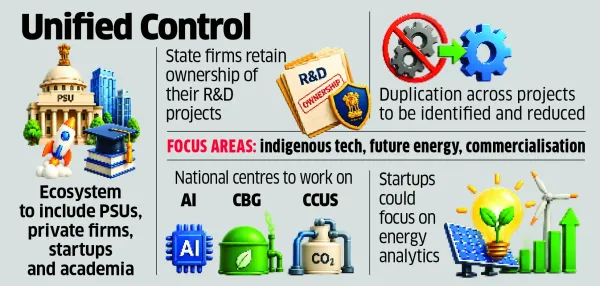 "Going forward, all new R&D projects proposed under the petroleum ministry R&D ecosystem will be submitted to the CRCM and assessed through the standardised project allocation framework for allocation to the entity, or combination of entities, best positioned to execute them," the draft has proposed. "Private industry participants may also bring forward problem statements/R&D requirements, which can be assessed and directed to the appropriate ecosystem participant(s)."
State firms will "continue to own and execute their respective R&D projects" while the CRCM will interface with them "through a layered governance architecture", according to the draft. The CRCM is also expected to identify and reduce duplication across R&D projects.
Also Read:
An industry executive said the draft suggests the proposed coordinating body would have significant powers over state companies' R&D programmes, potentially reducing their autonomy in the area.
"Setting national priorities in R&D is a laudable objective but reducing competition in the name of duplication and controlling every project or funding may not bring the desired result," he said.
At present, all have dedicated R&D departments headed by a director or executive director. 's R&D chief has a seat on the company's board, although the position is currently vacant.
The oil ministry's proposed ecosystem aims to bring together R&D centres of state-owned companies, national centres of excellence, private companies, startups and academia. "Each entity will play a differentiated role across the R&D lifecycle," per the draft.
State firms could work on research related to fuel grades and energy efficiency, while the private sector could focus on areas such as new process technologies and catalysts, according to the draft. National centres of excellence could take up areas including digital technologies, artificial intelligence, compressed biogas (CBG) and carbon capture, utilisation and storage (CCUS), while startups could focus on energy analytics.
The ministry has identified indigenous technology, leadership in future energy technologies and commercialization-led innovation as strategic themes for sectoral R&D, following a consultation in May with the leadership and R&D heads of oil PSUs. "The overarching ambition is to create an ecosystem that aligns institutions around common national priorities, strengthens coordination and accountability, and improves the effectiveness of R&D investments," per the draft.
Contact to : xlf550402@gmail.com
Copyright © boyuanhulian 2020 - 2023. All Right Reserved.