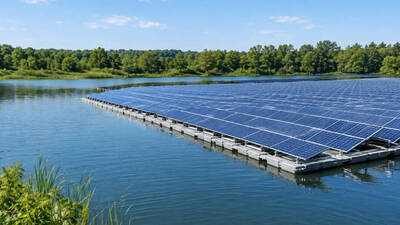
The floating solar panels are installed on reservoirs, lakes and ponds and are presented as a method for producing renewable energy without occupying farmland or conservation land. The installation takes place on small water bodies and according to the authors of a field experiment conducted in 2024, more than 90% of all the floating solar energy installations around the world are installed on water bodies that have an area smaller than one square kilometre. In 2023, Nicholas Ray, Meredith Holgers and Steven Grodsky installed floating solar panels over 70% of the surface of three ponds at the Cornell Experimental Pond Facility in New York. The research, titled “The Immediate Effect of Floating Solar Energy Deployment on Greenhouse Gas Dynamics in Ponds,” was published in These panels had an effect on the water body. Daily greenhouse gas emissions from the ponds increased by 26.8% in carbon dioxide equivalent, while dissolved oxygen fell rapidly.
3 of 6 matched ponds had 70% of their surface covered by floating arrays
In 2022, researchers sampled ten ponds and selected the six with the most similar characteristics. Each of them measured 30 x 30 m and contained no fish. Floating areas were mounted on the surface of three of these ponds from June to September in 2023, while the remaining three served as control ponds. The arrays did not generate electricity because the experiment tested only the effect of the panels’ physical cover, and they were removed and recycled afterwards. Although 70% coverage is higher than the median coverage of approximately 58% for 0.001 sq.km ponds, it still fits the existing range of pond and lake panels. Higher bubbling methane emissions offset the reduction in diffusive CO2 and methane.  Both decreases occurred due to the slowing of gas exchange with the atmosphere by the arrays. Emissions of methane from the sediment in bubbles increased by 57.2%, which offset the mentioned decrease entirely. The dissolved CO2 content in the pond surface water increased more than twofold in the presence of panels, to 121.1 micromoles per litre against 45.1. The rise became minimal during cool months. However, the increase was not consistent throughout the year since the above-mentioned research shows that there was no significant effect on emission in cool months, which naturally have less bubbling.
There was a 73% reduction in surface sunlight under a German lake array
A separate study published in examined the effects of floating photovoltaic plants on lake water temperatures and thermal stratification. The researchers studied a 749 kWp floating PV array installed on Lake Maiwald, a 70 m deep dredged lake in southwestern Germany, which is very different from the shallow Cornell ponds. There was a 73% reduction in surface sunlight and 23% reduction in the near-surface wind speed under the array while it covered 2% of the lake. Simulation of the effects of higher coverage showed more unstable and shorter summer stratification. Although the German lake is much deeper and has far lower coverage than the Cornell ponds, both studies indicate that arrays influence light and wind at the water surface.
Water use emissions were 2.61 g/kWh
According to the study in Environmental Science & Technology Letters, the carbon emissions associated with the change in water use amount to 2.61 g of carbon dioxide equivalent per kilowatt-hour. Incorporation of the pond emissions increases the life-cycle estimates of floating solar by 4.0% to 6.5%. The authors note that 70% coverage is at the high end of what is used in existing floating solar installations, so the values estimated above may be towards the upper end of what to expect. In order to minimise the effects, it is advisable to set limits on panel coverage, change the angle and height of the panels to ensure that air can get to the water and suspended aeration apparatus below the panels.
Contact to : xlf550402@gmail.com
Copyright © boyuanhulian 2020 - 2023. All Right Reserved.