
Bhushan Bhalerao started with Rs. 600 a month. Today, the 36-year-old assistant manager at the Reserve Bank of India (RBI) gives Rs.5,250 every month on standing instructions, most of it towards girls’ education. An engineer himself, he was moved by his three college roommates, who came from financially difficult homes and are all doing well today. Education, he concluded, changes lives. Every raise has meant a bigger donation. “Whenever my salary increased, I increased my SIP (systematic investment plan), and similarly, I increased the amount I donate,” says Bhalerao.
Bengaluru-based retailer Faraz Adil Fazal, 40, gives by the book. A practising Muslim, he pays zakat (obligatory charity) every year: 2.5% of his liquid wealth, after the year’s expenses. Yet Fazal leaves room for the moment. Once, an auto-rickshaw driver stopped him outside one of his shops and asked for help with his daughter’s school fees. Fazal asked a few questions, then paid. The next year, the man came back with his daughter’s results and the next year’s fees. Fazal paid again. “Whenever you get approached, do something. It doesn’t matter whether it is Rs.2,000 or Rs.5,000 or Rs.10,000,” he says.
Neither writes the kind of cheques that make it to philanthropy lists. Both have made giving a habit.
Who pays for India’s social sector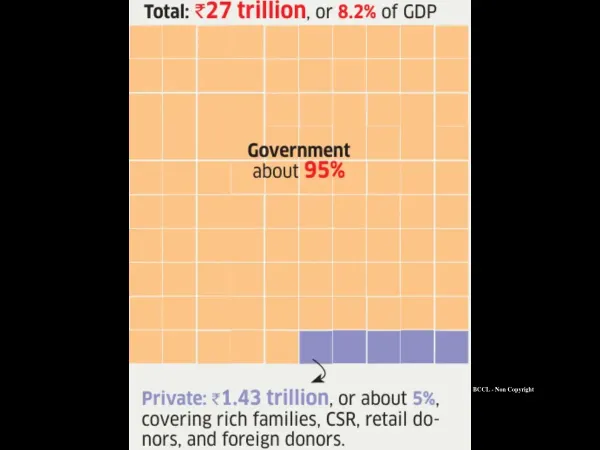 Source: Bain-Dasra India Philanthropy Report 2026
GIVING ON STANDING INSTRUCTIONS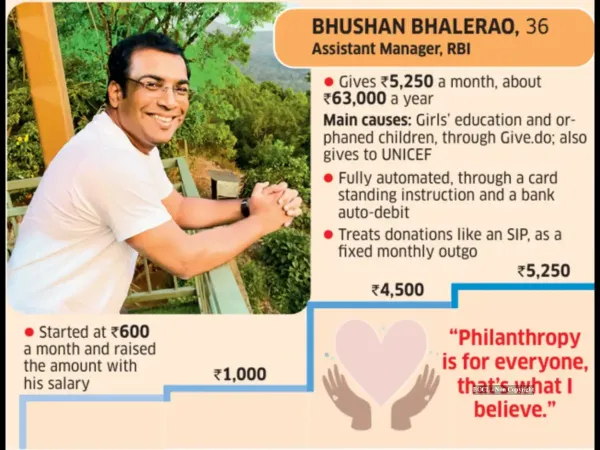 It’s the habit, not the size
Vishal Dhawan, founder of Plan Ahead Wealth Advisors, a Sebi registered investment advisory firm, sees money largely going out on three fronts: helping one’s own domestic staff with their welfare or their children’s education, religious giving as per what customs prescribe, and structured giving, like giving money or time for a specific cause.
For Brinda Upadhyaya, Co-founder of the Upadhyaya Foundation and Founder of Accelerate Indian Philanthropy (AIP), giving started small. Mumbai-based Upadhyaya, who runs her foundation with her husband, Ajay, began in the early 1990s on a modest college lecturer’s salary, giving small amounts to a few women who rescued stray dogs from being culled. What stayed with her, though, were the taxi drivers she used to spot near Juhu, who would park their taxis for lunch but make sure they fed a chapati or two to stray dogs. “Their wives had instructed them not to have a morsel of that food until they fed the dogs. This shows that even if you earn Rs.10,000 a month, you can always give Rs.50,” she says.
Kind as it is, such everyday giving barely registers in the bigger picture.
Data from the Bain-Dasra India Philanthropy Report 2026 shows that India spends about Rs.27 trillion a year on the social sector, 8.2% of GDP. Roughly 95% of it is government spending. Only Rs.1.43 trillion, or about 5%, comes from private funding. And only a part of that comes from ordinary individuals. The good news: retail giving is expected to grow 9-11% a year, which the report credits to the spread of UPI (Unified Payments Interface) and digital giving platforms such as crowdfunding.
ALSO READ |
But here’s how short India falls. By NITI Aayog’s yardstick for meeting the UN’s Sustainable Development Goals, the report estimates India’s social sector falls short by about Rs.16 trillion a year.
No one expects you to fill that gap. But you can give regularly, and give better.
How much should you give?
There is no single number. Upadhyaya suggests 2-5% once a person has identified where (s)he wants to give, or by contributing something every year during Diwali or any such festival. “It should not be a scratchy philanthropy or charity,” she says.
It could be a percentage of surplus, like Fazal’s zakat, which flexes in bad years, such as during Covid-19, when his shops were shut. “The way I look at it is: I cleanse my wealth by giving 2.5% back every year,” says Fazal.
Mumbai-based Ramakrishnan K., 55, and his wife Keerthana, salaried professionals all their working lives, fixed a share of their net income for giving years ago. Their incomes grew; the share stayed the same. “Whether you earn Rs.10,000, Rs.1 lakh or Rs.10 lakh, the percentage should not change,” says Ramakrishnan, a former managing director at market research firm Kantar. “This money is not ours, and therefore we give it to people.”
A Maharashtra-based entrepreneur, who spoke to us on condition of anonymity, prefers to give a share of the ask. When a hospital in his city needed a cardiac ambulance costing Rs.25 lakh, he donated the first cheque of Rs.5 lakh. Others followed, and the hospital raised the remaining Rs.20 lakh in a week. “We never give the full amount; we always give the first 10-30% of the total amount that is sought to be raised.”
Dhawan says many of his clients contribute at least 2-3%, which can go up to around 10%. “Start sharing, as soon as you see the joy of it, you will start to give more and hopefully make it a regular habit,” says Srikanth Bhagavat, Managing Director, Hexagon Capital Advisors, which runs Hexagon Wealth.
GIVING BUILT INTO THE RETURN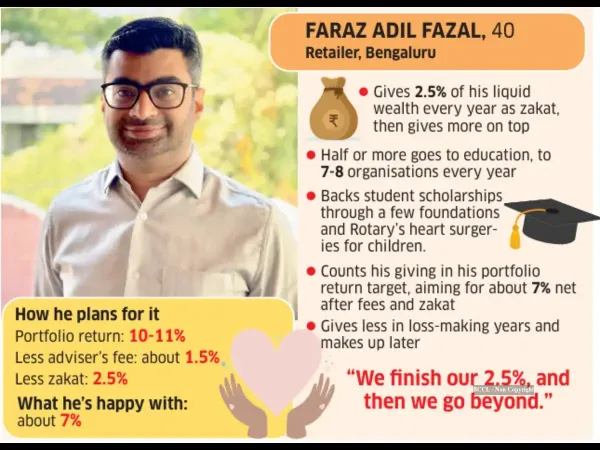 FROM RICE TINS TO SIPs
Make it stick
Committed donors say it’s important to make giving a habit, just like an SIP. Karthik Davey, 52, a tour operator who owns a six-unit safari lodge in Bandipur, Karnataka, is part of a group of animal lov ers who support the Nilgiris Society for the Prevention of Cruelty to Animals (NSPCA) in Ooty, Tamil Nadu. Every month, he pays half the salary of the driver of its animal ambulance. Despite the quieter off-season months at his lodge, when fewer tourists head into the forest, Davey ensures his contribution never misses a month. “I make sure that my money is available, no matter what,” he says.
To avoid missing a month, Bhalerao turns to his credit card and bank account. He gives Rs.4,500 a month to a platform called Give.do for education through a credit card mandate, and the remaining Rs.750 to UNICEF through a standing instruction on his bank account.
Bring in your planner
Financial planners say giving has slowly emerged as one of the financial goals people set for themselves. Bhagavat says giving is one of the items on the goal sheets that new clients fill out at his firm. “In younger clients, the focus is on their own experiences, like travel, cars, home upgrades, and so on. After age 50, if you have more than what you need, we bring that into our questioning…what would you like to leave behind for a cause or would you like to give away something during your lifetime,” says Dhawan.
Financial planning for giving is pretty much like most other goals. Dhawan says short-term giving needs are met with investments in money market funds; the longer-term giving corpus goes into equity and hybrid funds. Bhagavat treats a philanthropy corpus like a retirement corpus.
ALSO READ |
Is giving negotiable? “In the earning years, giving is still discretionary because you are building your corpus and you have responsibilities. But the idea of sharing is to give from what you have, so cut your giving only if other critical goals can’t be met,” says Bhagavat.
What about tax? Donations to eligible charities qualify for a deduction under Section 133 (Section 80G as per the old Income Tax Act, 1961). Bhalerao claimed the deduction under the old regime but has since moved to the new one. “I am not donating for tax purposes; I never did,” he says.
How to choose a cause?
For most donors we spoke to, the cause found them. While taking his father to a hospital in his hometown for cancer treatment, the anonymous donor noticed young girls whose parents often chose not to pursue treatment, fearing they would be left with no money for their daughters’ weddings. His father passed away that year. For the next six years, he marked his father’s birthday by sponsoring the cancer treatment of two girls at the same hospital.
Time, skills or money?
Meet Khushi Desai, 24, a Surat-based financial educator. She could have written a cheque, but chose to give her time instead. From a finance-oriented family (her father, Jignesh, is the Co-founder of NJ India Invest, one of India’s largest mutual fund distributors), she conducts workshops on investments, mutual funds, and finance. She began with flower pickers at an ashram near Palghar, Maharashtra. Asked whether they used bank accounts, nobody raised a hand. They kept cash in rice boxes and red chilli powder tins “because no one will steal it from there,” she said, quoting them. After her session, all the 20-odd participants started investing, for the first time.
Over the last year, she has conducted 177 sessions, reaching more than 22,000 participants across 52 districts, as of 12 October 2026. People confuse savings and investing, she says. “I have seen too many people calling me and asking me, ‘I’ve been investing for three months, and this is not increasing’… We are talking about 10 years, 15 years.”
Giving time is not always easy. Chandni Parekh, a social sector pro fessional who has connected ‘givers’ with many NGOs over the past 20 years and now advocates for a school run by the NGO Tamarind Tree, laments the absence of a BookMyShow style model for giving: a hyperlocal platform that matches people with a wide range of volunteering op, both nearby and online. “A comprehensive platform would widen the pool of donors, reducing dispari ties in access, but it appears that nobody wants to invest in building such a platform,” she says.
Directly or through a platform: How to vet?
Who should you give to: a platform, an NGO, or the beneficiary directly?
Bhalerao prefers to give through Give.do, a platform that connects NGOs and donors. He chooses the cause; the platform then chooses the best-suited NGO. “I believe in giving to institutions since they will pull money for many people and create a better atmosphere for children collectively. I have never donated to an individual,” says Bhalerao.
Upadhyaya’s foundation takes about three to six months to hand over the first cheque to an NGO. A three-person team checks the NGO’s registration, paperwork, and audited accounts, and she often visits the NGO over two to three days to see things on the ground. “We always give to registered non-profit organisations, never to individuals,” says Upadhyaya.
“A first-time giver should look beyond just the headline impact numbers. Start with the basics: is the prob lem clearly defined, does the organisation have a credible approach and leadership team, and are its finances and governance transparent?” says Radhika Jain, Philanthropy Partner and Chief Operating Officer, Accelerate Indian Philanthropy.
Light the first lamp
Giving, then, need not wait for a big bonus or a foundation of your own. Bhalerao began with Rs.600 a month. Fazal gives his 2.5% and never turns away anyone seeking help. Desai gives her time. Pick a cause, fix an amount, automate it and check where it goes.
And sometimes, giving is about what you choose not to do. “Diwali is coming up. Do not burst firecrackers. Even the action of not doing something is actually a contribution to cleaner air, better health outcomes, less trauma for so many of the street animals,” says Upadhyaya.
Contact to : xlf550402@gmail.com
Copyright © boyuanhulian 2020 - 2023. All Right Reserved.