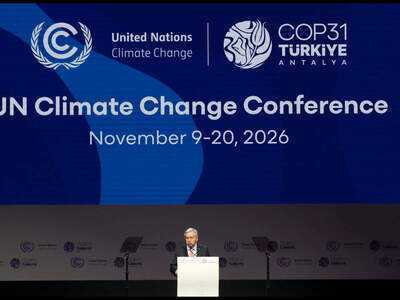
Antalya: Nations must face the brutal truth that the is outrunning us, said the head of the Antonio Guterres to the world leaders attending the climate talks in the Turkish Mediterranean city. Speaking at his last UN climate conference as the head of the multilateral body, Guterres identified climate justice as the defining challenge for the next decade, called for a "new based on shared responsibility, shared security and shared benefits".
The UN chief reminded world leaders that emissions in 2025 reached all-time highs, every year set new heat records with the last four years the hottest ever, climate disasters were "pounding lives, livelihoods and economies across the globe" and "fossil fuel interests keep making a killing ... while killing our planet" and that overshoot above 1.5 degrees is now inevitable. Despite this, Guterres said all was not lost, but getting the world off this dangerous course "demands leadership".
"We have the power to make sure the overshoot is a temporary breach, not a permanent sentence. That demands leadership. We know the truth. Now we must act on it. Because is more than a fight over numbers on a thermometer. We are in the fight for our lives and our children's future," he said.
At a time when countries are being asked to focus on implementation of commitments and decisions adopted at COPs past, and with roadmaps galore to do so. Guterres took the opportunity to set out the defining parameters that are critical for any sustainable transition and transformation. Nudging countries away from the paradigm of brinkmanship that has come to characterise these multilateral climate talks, Guterres said that demanding countries transform their economies while denying them the means to do was simply not on. In doing so, he articulated the concerns that have been voicing long before Antalya.
"Emerging and developing economies outside China are home to nearly two-thirds of humanity, yet they receive less than one-fifth of . Most pay two to three times more to borrow.
If they cannot access affordable clean energy, will fill the gap - locking in emissions for decades.
And if vulnerable communities cannot adapt, instability will spread across borders," Guterres warned. The UN chief called on all countries to do their part but stressed that the principle of common but differentiated responsibilities must apply. "Developed countries cutting emissions faster - and delivering the finance and technology they promised. Emerging economies accelerating their shift from fossil fuels to renewables. And developing countries receiving massive support to adapt."
Outlining the four pillars of the Climate Justice Compact, Guterres called out the double speak on fossil fuels. "Leaders, and in particular those from developed countries, cannot keep expanding fossil fuel production while claiming to be committed to 1.5 degrees."
Among the world leaders taking in Guterres' words were Turkiye's President Recep Tayyip Erdogan, Australian Prime Minister Anthony Albanese, and Brazil's President President Luiz Inacio Lula da Silva and some 90 other world leaders. Just ahead of , President Erdogan announced the "encouraging" discovery of two new oilfields. Australia is the second-largest exporter of fossil fuel CO₂ emissions
Drawing on the recent UNEP Emissions Gap report, Guterres set the timeline--by 2035, global must at least triple from 2025 levels, while unabated coal power must fall by at least 75% and by 2040, unabated coal power must be all but phased out - and oil and gas use cut by around a third.
Contact to : xlf550402@gmail.com
Copyright © boyuanhulian 2020 - 2023. All Right Reserved.