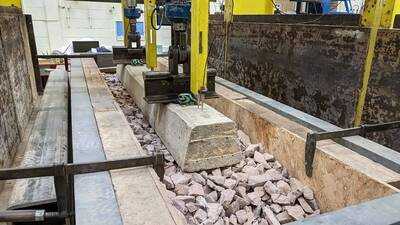
Scottish engineers have developed a self-levelling railway sleeper made from recycled plastic that could help railway tracks correct minor unevenness without requiring workers to carry out repairs manually. The technology, developed by researchers at Heriot-Watt University alongside international collaborators, is designed to address one of the railway industry's persistent maintenance problems, particularly around bridges and tunnels. According to Heriot-Watt University, the innovation could improve track stability , reduce maintenance costs and minimise passenger disruption while giving discarded plastic a useful role in railway infrastructure.
How could self-levelling railway sleepers reduce track maintenance costsThe research addresses a problem known as transition zones, which are among the most troublesome sections of railway infrastructure. As explained by Heriot-Watt University, these are locations where track support changes suddenly, including where railway lines meet bridges, tunnels or embankments.
Such changes can cause the ground under the track to settle unevenly. The ground under an embankment may settle slowly, but the structure of a bridge or tunnel is relatively stable. The difference means that there are gaps under the rail sleepers and some are unsupported.
These unsupported sleepers are known as hanging sleepers. Rather than resting firmly on the crushed stone beneath the track, they can become suspended above it, creating conditions that affect how trains move across the railway.
The uneven distribution of loads of trains leads to increased wear and tear of rails, sleepers and the supporting stone layer, states Heriot-Watt University. This results in more frequent maintenance requirements, speed restrictions and passenger discomfort for railroad operators.
The university noted that millions are spent annually across Europe's railway network maintaining transition zones, highlighting the financial burden associated with these relatively small but problematic sections of track.
How does the recycled plastic sleeper correct uneven tracks automatically
The self-levelling sleeper developed by Heriot-Watt engineers is designed to respond when gaps develop beneath it. Instead of relying entirely on workers to restore support, the sleeper incorporates a mechanism that adjusts its position automatically.
Dr Ahmet Furkan Esen, an assistant professor at Heriot-Watt University's School of Energy, Geoscience, Infrastructure and Society, explained that the mechanism operates similarly to a self-adjusting jack.
When the ground settles and a gap appears beneath the sleeper, the internal mechanism lowers its base until contact with the supporting stone is restored. This allows the sleeper to compensate for minor changes beneath the railway without requiring immediate manual intervention.
The design aims to prevent the damaging effects associated with unsupported sleepers, helping maintain more consistent support beneath passing trains.
Railway Gazette International , in its report on the development, highlighted the technology's potential to address persistent problems at transition zones. The innovation offers a different approach to railway maintenance by allowing the track support itself to respond to developing faults.
The sleeper is also manufactured using recycled plastic, giving discarded material a long-term application in railway infrastructure. Heriot-Watt University said this could reduce dependence on newly produced raw materials while supporting a more sustainable approach to railway construction.
What did the engineers discover during full-scale testing
The researchers tested full-sized sleeper prototypes at Heriot-Watt University's specialist railway testing facility in Edinburgh. The university describes it as the largest purpose-built railway test track facility of its kind in the UK.
The testing environment can reproduce forces generated by high-speed trains and simulate the effects of decades of railway operation under controlled conditions. This allowed the researchers to examine whether the self-levelling mechanism could function under demanding loading conditions.
According to Heriot-Watt University, the team conducted 600,000 loading cycles over three days. Forces of up to 41.7 kilonewtons were applied at each rail seat, equivalent to a 17-tonne axle load.
The researchers also deliberately created voids beneath the sleepers to simulate the slow ground settlement that occurs along railroad lines. Sensors built into the supporting stone measured how the loads and pressure were distributed during the tests.
The results showed that the self-leveling mechanisms were activated when gaps formed under the sleepers. The prototypes made contact again with the supporting stone and maintained a stable load distribution under the rails.
The university said the sleepers were able to bridge gaps up to 40 mm in tests. This was especially important as it showed that the mechanism could respond to heavy loss of support without the immediate need for traditional repairs.
Could the railway technology reduce passenger disruption
Heriot-Watt University explained that transition zones frequently require maintenance because uneven settlement gradually damages track components. Repair work can involve operational restrictions, while deteriorating track conditions can also lead to speed limits that affect passengers.
By automatically restoring support beneath sleepers, the technology could reduce the frequency of maintenance interventions and help rail operators keep tracks in better condition.
The university said the development could improve passenger comfort, reduce disruption and lower overall maintenance costs throughout the sleeper's service life.
The design has also been developed to fit standard railway tracks and work with commonly used fastening systems and existing maintenance practices. This compatibility could make the technology easier to integrate into established railway infrastructure if it progresses towards wider deployment.
The development follows 4 years of research into self-levelling sleepers, with findings reported in the journal
The project received funding through the European Union's Horizon 2020 programme under the Shift2Rail Joint Undertaking, as part of the IN2ZONE project. The positive lab results provide evidence that the mechanism can function under simulated railway conditions.
Contact to : xlf550402@gmail.com
Copyright © boyuanhulian 2020 - 2023. All Right Reserved.