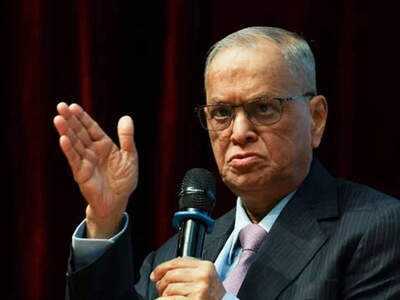
founder NR on Thursday called for a nationwide involving 10,000 accomplished retired STEM educators from India and developed countries, saying it could help build the foundation for India's long-term economic growth and innovation capacity.
Delivering a virtual address titled "Laying a Strong Foundation for the Prosperity of India" at the Infosys Prize 2026 announcement event in Bengaluru, Murthy said India must invest heavily in improving the quality of school education if it aims to become a global innovation powerhouse.
"We could invite 10,000 accomplished retired STEM teachers from the developed world and India to run 2,500 'Train the Teacher' colleges across states and union territories," said the tech veteran who pioneered the global delivery model for software services.
Under the proposal, each team of four educators would train 100 primary school teachers and 100 secondary school teachers annually. "That is 500,000 teachers every year. Within five years, those we train would themselves become trainers," he said.
Murthy estimated the initiative would cost about $1 billion a year and $20 billion over 20 years, an investment he described as affordable for a country aspiring to become a $5-trillion economy. Quoting a line often attributed to former Harvard University president Derek Bok, he said: "If you think education is expensive, try ignorance."
Murthy noted that he had advocated similar ideas from the same platform in previous years. "These ideas are time-invariant and context-invariant. Unfortunately, for some reason, we have not acted on them," he said.
The Infosys founder argued that nations become economically powerful through invention and continuous innovation, both of which stem from strong education systems and research ecosystems. He outlined four stages of economic development: countries that neither invent nor innovate; those that adopt inventions from elsewhere; those that improve on existing ideas through research and higher education; and nations that become global leaders in invention.
He cited South Korea's advances in electronics and storage technologies and India's global delivery model in software services as examples of the third stage.
Assessing India's progress, Murthy said achievements in atomic energy, space, vaccines, the Green Revolution and generic medicines have placed the country in stage two in several sectors and stage three in software services. However, challenges such as urban congestion, pollution and inadequate access to clean water show that parts of the country remain in the earliest stage of development.
India must aspire to reach the highest stage across sectors that directly affect the lives of its poorest citizens, he said. Achieving that goal would require stronger research capabilities, better education, faster execution and a culture built on ambition, discipline, curiosity and a willingness to learn from global best practices.
"It begins in our classrooms," Murthy said, adding that schools should encourage independent and analytical thinking, Socratic questioning and the ability to connect theory with real-world problems. He also stressed the need to improve the status of teachers and researchers through better pay, stronger institutional support and public recognition.
Referring to the Infosys Prize, instituted in 2009, Murthy said this year's laureates were among the world's most promising young researchers and that the award was intended to encourage them to achieve even greater accomplishments in the years ahead.
Contact to : xlf550402@gmail.com
Copyright © boyuanhulian 2020 - 2023. All Right Reserved.