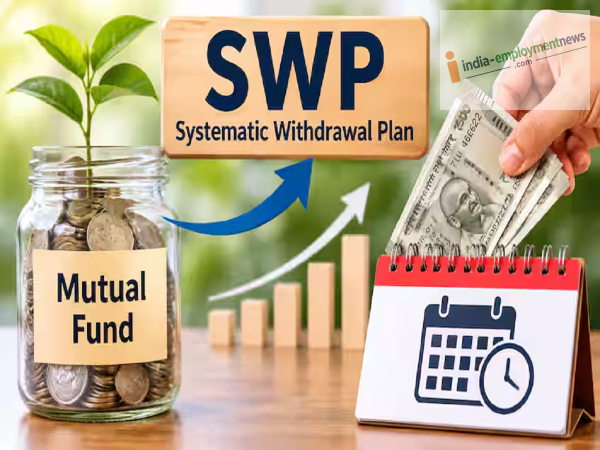
If you withdraw ₹10,000 every month from a ₹20 lakh mutual fund investment through a Systematic Withdrawal Plan (SWP)—assuming zero returns—the money will last for 16 years and 8 months. However, if the investment earns an annual return of 4%, 5%, or 6%, this duration could be even longer.
If you have accumulated ₹20 lakh in a mutual fund and wish to generate a regular monthly income from it, a Systematic Withdrawal Plan (SWP) could be an ideal option. Through an SWP, you can withdraw a fixed amount from your mutual fund investment every month. A key advantage is that the remaining balance stays invested in the fund, continuing to earn returns based on market performance.
If you have a ₹20 lakh mutual fund investment and withdraw ₹10,000 each month, how many years will the funds last? Can this investment cover your expenses over the long term?
What is an SWP, and how does it work?
An SWP is a mutual fund facility that allows investors to withdraw a fixed amount from their investment at regular intervals. You can choose to make withdrawals monthly, quarterly, or at any other frequency that suits your needs.
When you initiate an SWP, a specific number of mutual fund units are sold, and the proceeds (the fixed amount) are transferred to your bank account. The remaining units stay invested in the fund, continuing to generate returns based on market fluctuations. In other words, your entire investment is not depleted all at once; instead, you can withdraw funds gradually, as and when needed.
If you have a total investment of ₹20 lakh in a mutual fund and choose to withdraw ₹10,000 every month, you would be withdrawing a total of ₹1.20 lakh annually. What happens if you earn returns of 4%, 6%, or 8%?
If your mutual fund investment generates annual returns at varying rates, and you withdraw ₹10,000 every month, how long will your money last?
Estimated Annual Return | Estimated Duration |
|---|---|
0% | 16 years and 8 months |
4% | Approximately 27 years |
5% | Approximately 34 years and 7 months |
6% | Approximately 62 years and 4 months |
Will your money never run out if you earn a 7% return?
If an investment of ₹20 lakh consistently earns an annual return of 7%, the monthly return generated on the initial investment exceeds the ₹10,000 monthly withdrawal. In this scenario, it is possible that your fund may never be exhausted.
However, mutual fund returns do not remain constant from month to month; the market experiences both ups and downs. If you continue to withdraw a fixed amount each month even during a market downturn, you may need to sell a larger number of units. This could negatively impact the future recovery of your investment. Therefore, it is not advisable to determine the duration of a Systematic Withdrawal Plan (SWP) based solely on average returns.
Points to consider before starting an SWP:
Mutual fund investments are subject to market risks, and the returns are not guaranteed.
When selecting a fund for an SWP, it is essential to understand its investment strategy, associated risks, historical performance, and your own investment horizon.
Each withdrawal under an SWP involves the redemption of a certain number of mutual fund units. Any resulting capital gains may be subject to taxation as per applicable tax laws.
If you have a mutual fund investment of ₹20 lakh and wish to withdraw ₹10,000 every month, your money would last for 16 years and 8 months, assuming zero returns. If the investment generates returns, this duration could extend significantly. However, actual outcomes may vary due to market fluctuations.
Contact to : xlf550402@gmail.com
Copyright © boyuanhulian 2020 - 2023. All Right Reserved.